
Through the Trees

America 250 NC is North Carolina's commemoration of the United States' 250th anniversary and is led by the N.C. Department of Natural and Cultural Resources. Join us in celebrating this historic anniversary of the signing of the Declaration of Independence by visiting NC Parks to meet trees with a stories to tell.
Tangible connections to our natural and human history:
North Carolina’s State Parks contain a diverse range of forest ecosystems from swampy cyprus forests in the east to spruce-fir forests in the west. Park staff from across the state have selected a witness tree to share with you. These trees tell a story about the history of the park and the lands they now occupy. As we celebrate the 250th anniversary of the signing of the Declaration of Independence, visit one of these iconic trees.
Explore the witness trees that have been selected by parks and plan your visit.
The witness tree will be identified by a sign but you are encouraged to stop by the park office to ask for assistance locating it or to obtain a map.
Witness Trees in Our Parks
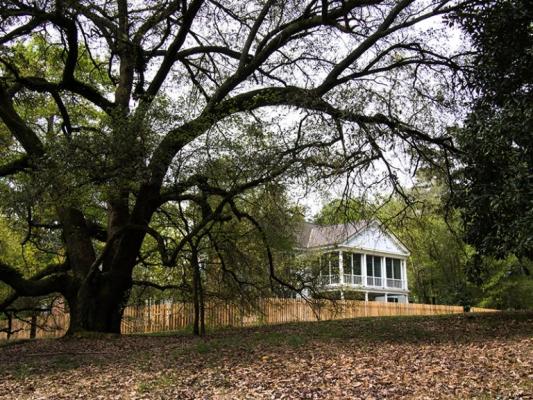
About the Witness Tree
Species: Southern live oak
Scientific Name: Quercus virginiana
Age: About 85 years old
James Stillman Rockefeller acquired this property in 1937 from his uncle Percy Rockefeller and business partner Windsor White. He and his wife, Nancy Carnegie, built their home near the millpond and transplanted a few live oaks gifted by a friend of Nancy’s to remind her of home.
Over the years, this tree has quietly witnessed the comings and goings of Rockefeller’s Airborne Command meetings, farmworkers tending the land, and countless family gatherings on the pond for swimming, paddling, and fishing. Today, it continues to provide shade for visitors, serves as a backdrop for weddings and picnics, supports educational programs, and offers habitat for a variety of wildlife.
Directions to the Witness Tree
Over 250 bird species have been recorded at Carolina This tree can be reached by hiking approximately half a mile along the Rockefeller Loop Trail to the Rockefeller House, then walking around to the front of the house near the millpond.
bald eagles are easily recognized by their fully white heads.
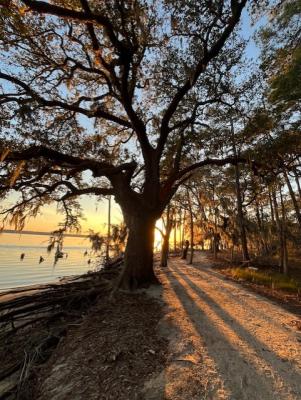
About the Witness Tree
Species: Southern live oak
Scientific Name: Quercus virginiana
Age: About 150-200 years old
For 150 years, this tree has stood on the shores of the Pamlico River, its roots embedded in what is now Goose Creek State Park. It sprouted long before the park existed. In the late 1800s, it would have witnessed loggers working the region and barges, stacked with longleaf pine and cypress, drifting down the river, bound for sawmills in Washington and beyond. Somehow, this tree survived — too small to harvest, or perhaps simply lucky. Remnants of the past — old railroad beds, piers, and charred tar kilns — still dot the landscape.
By September 1974, the land surrounding this tree became Goose Creek State Park. Over the decades, the forest returned where clearings had been, and scientists and visitors came to learn the stories held within these woods.
Today, its wide canopy shelters visitors enjoying the water views. Owls perch in its branches, gray squirrels scurry along its limbs, and the shoreline gradually creeps closer, exposing roots once hidden beneath the soil. Yet, unlike so many of its neighbors, this tree endures — 150 years later, still standing, still watching, and still holding on.
Directions to the Witness Tree
This tree can be found along the Live Oak Trail, on the river’s edge. It is the largest tree in sight.
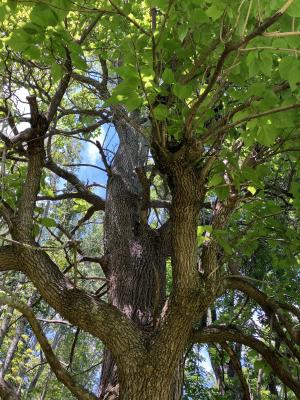
About the Witness Tree
Species: Southern catalpa
Scientific Name: Catalpa bignonioides
Age: Unknown
Acquired by the state of North Carolina in 2009 from the High Country Conservancy (now the Blue Ridge Conservancy), this state natural area now protects over 350 acres of forested mountain slopes and streams.
Standing beside the cabin built in 1965, this magnificent southern catalpa is one of the largest that our staff have encountered. Southern catalpas thrive in moist soils near rivers and streams and are easily recognized by their large, heart-shaped leaves and long, slender seedpods — earning them the nickname “cigar trees.” Their flowers and leaves provide food and shelter for pollinators, birds, and mammals, making them an important part of this thriving mountain ecosystem.
Directions to the Witness Tree
This tree is located at Bear Paw State Natural Area, to the right of the cabin. To see it, park at the end of Dutch Creek Road (approximate address: 2982 Dutch Creek Road, Banner Elk, NC, 28604) and walk up the road from the park gate — vehicle access beyond the gate is not permitted.
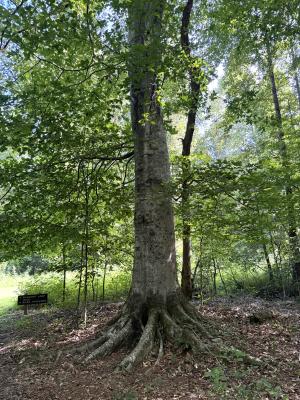
About the Witness Tree: American Beech
Species: American beech
Scientific Name: Fagus grandifolia
Age: About 210 years old
About 30 years after the birth of our nation, a seed sprouted and began its long journey toward becoming the majestic American beech standing before you today.
In this tree’s early years, it shaded travelers heading west in search of new beginnings. By the time it reached maturity, around 40 years old, a storm was rising in the South. When North Carolina entered the Civil War, this beech would have stood in still witness as soldiers marched and organized nearby. And when peace returned in the spring of 1865, its pale yellow-white blossoms would have signaled both renewal and relief after a long, cold winter.
Decade after decade, the tree continued to grow — as did the people around it. A century later, it likely towered beside open fields, offering cool shade to farmers resting from their work. Much of the land that now forms Haw River State Park was once cleared for agriculture. What you see today — the forest surrounding this trail — is the result of natural regrowth, as fields slowly gave way once more to woodland.
Today, this ancient beech witnesses a new kind of story: one of joy, discovery, and connection. Its roots intertwine beneath your feet, linking centuries of history, growth, and life within the soil.
Directions to the Witness Tree
This tree stands along the Piedmont Loop Trail, just before the boardwalk. From the rear exit of the Main Lodge, follow the concrete path across the bridge toward the cabins. Continue behind the cabins on the Piedmont Loop Trail until you reach a four-way intersection. Turn right to stay on the Piedmont Loop Trail. As the trail approaches a gas line clearing, look to your right — the tree stands there, just before the opening.
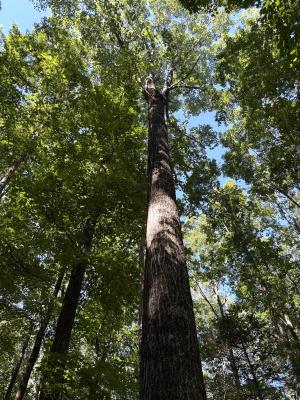
About the Witness Tree: Northern Red Oak
Species: Northern red oak
Scientific Name: Quercus rubra
Age: About 130 years old
This towering oak began its life as a small acorn that managed to survive hungry squirrels and burrowing weevils. That was long ago — over a century past. Today, it stands at Haw River State Park’s Iron Ore Belt Access.
This tree silently keeps the stories of everything it has observed — and all that is still to come. Your presence here now becomes part of its living memory. Within its rings are the echoes of train whistles piercing winter nights, and the rumble of railcars carrying denim and flannel from Greensboro’s mills. This tree has seen vast crop fields and distant farmhouses. It holds the warmth of picnics shared under its radiant red canopy on golden autumn afternoons.
This tree has seen us — our growth, our care, and our change. What do you think it will witness next?
Directions to the Witness Tree
This tree can be found along the Great Blue Heron Trail at the Iron Ore Belt Access off North Church Street in Greensboro, NC. From the trailhead, walk about one-tenth of a mile — the tree will be on your left.
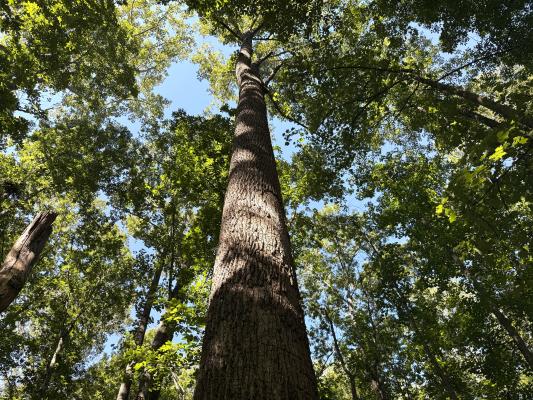
About the Witness Tree: Tuliptree
Species: Tuliptree
Scientific Name: Liriodendron tulipifera
Age: About 100 years old
This tree began as a small seedling in the midst of the Roaring Twenties, a time of rapid cultural change in the United States. New inventions and ideas were taking root — new fashions, mass-produced automobiles, and even bootlegging. The land around you was once an open farm, long before the forest returned. From here, this young tree may have seen Model T and A cars rumbling along distant roads, their drivers honing the daring skills that would later spark the sport of NASCAR.
As the decades passed, farmers sought the cool shade this tuliptree provided from the hot summer sun. Over time, as the forest naturally regenerated, wildlife of all kinds began to find shelter and food within its branches. In just a century, this tree has witnessed a world transformed — fields returning to forest, farms giving way to parkland, and now, you standing here beneath its leaves. Tuliptrees can live 200 to 300 years, so this one still has plenty of life — and stories — ahead of it.
Directions to the Witness Tree
This tuliptree can be found along the Iron Ore Belt Loop Trail, near its second intersection with the Great Blue Heron Trail at the Iron Ore Belt Access.
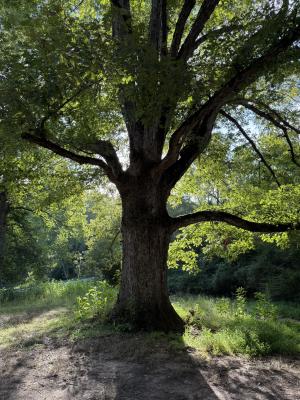
About the Witness Tree
Species: White oak
Scientific Name: Quercus alba
Age: About 272 years old
GPS Coordinates: 36.4185, -80.2841
The white oak is a slow-growing deciduous tree that can reach impressive heights of up to 135 feet. It provides an important food source for birds, deer, rodents, and many other wildlife species. This particular white oak stands in front of the historic Moore’s Spring Cookhouse, built in the late 19th century as part of the Moore’s Spring Hotel and its surrounding cottages. The Cookhouse is one of the last remaining structures from this once-thriving resort complex. In the early 1900s, vacation cottages and the Moore’s Spring Resort lined the adjacent Moores Spring Road. During that time, several mineral springs resorts flourished throughout this area of Stokes County, including the nearby Vade Mecum and Piedmont Springs.
Directions to the Witness Tree
This tree is located 3.9 miles from the visitor center, on Moores Spring Road, just before the mountain bike trail parking lot. To reach this tree, turn right as you exit the visitor center parking lot. At the park gate, turn left onto Moores Spring Road and continue for about 2 miles. After passing Ed Booth Road, cross the bridge over Cascades Creek and turn left onto an unmarked dirt road that leads to the mountain bike trail parking area.
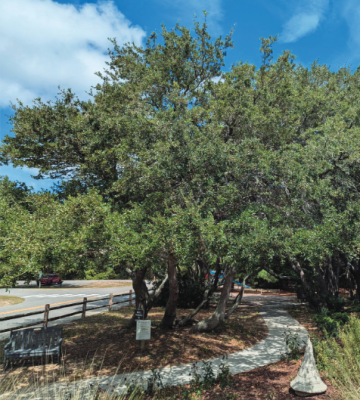
About the Witness Tree
Species: Southern live oak
Scientific Name: Quercus virginiana
Age: Unknown
This majestic tree provides shade on hot summer days and acts as a windbreak during storms. Its low, curving limbs create a magical canopy, while hundreds of acorns drop each fall, feeding local wildlife as they prepare for winter. Broad, horizontal roots anchor the tree during high winds, and its strong, durable wood has long been valued.
Unlike typical oaks, the Live oak partially sheds its short, glossy leaves in spring, offering perfect perches for birds. During the day, squirrels scurry along its limbs, while at night, opossums, raccoons, and even bobcats navigate its branches. This living witness has seen it all and continues to be a hub of life on the Outer Banks.
Directions to the Witness Tree
Look straight ahead from the landscape window in the Jockey’s Ridge visitor center, and you’ll see our Witness Tree! Take a moment to rest on the bench and learn more about one of the Outer Banks’ most iconic trees.
About the Witness Tree
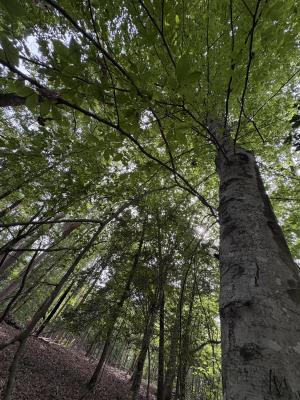
Species: American beech
Scientific Name: Fagus grandifolia
Age: Over 100 years old
The trail leads to an abandoned argillite quarry that was once operated by the Civilian Conservation Corps (CCC) during the late 1930s and early 1940s. Stone from this site was used to build many of the park’s original facilities. Morrow Mountain State Park was established during a time when many Americans were struggling with unemployment and hardship. Programs like the CCC provided young men with work, training, and a chance to help shape our nation’s first state and national parks.
As the Quarry Trail winds along a rocky stream with several bridge crossings, visitors encounter a variety of natural features. One of the highlights is a vernal pool wetland located within the old quarry. This seasonal wetland thrives during the winter and spring after the rains of fall replenish it. Amphibians come here to lay their eggs. By summer, as the pool dries, young salamanders and frogs
have matured and moved onto land.
Fall and spring are ideal times to visit for those interested in spotting migrating birds. The shaded bottomland forest supports many water-loving plants and trees, including several impressive American beeches along the stream. These trees are significant for the history they have “witnessed.”
Beech trees are often targets of vandalism due to their smooth, soft bark, which is easily carved into. Sadly, one of the most prominent beeches along the trail fell during a recent storm. Its massive trunk now rests near the historic CCC barbecue pit, serving as a natural reminder of the park’s living history.
Directions to the Witness Tree
This witness tree can be found along the Quarry Trail. From the park office, turn right to exit the parking lot and continue straight. The Quarry Trailhead begins at the Lower Picnic Area, which also offers parking for the swimming pool, restrooms, grills, and picnic shelters.
About the Witness Tree
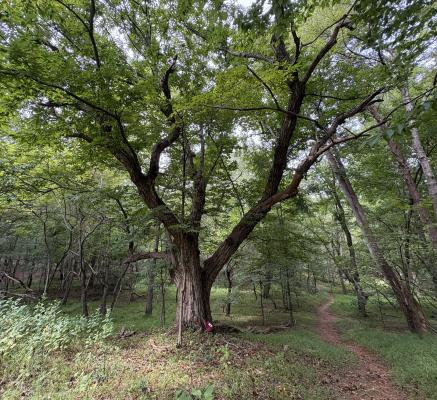
Species: Japanese chestnut
Scientific Name: Castanea crenata
Age: Over 140 years old
This tree stands on the grounds of the Kron family homesite and was planted by Dr. Francis Kron before his death in 1883. Dr. Kron was the first medical doctor to practice in the Uwharrie Mountains, traveling across the region to care for an underserved population that previously had little to no access to quality healthcare.
The Kron family was also well known for their horticultural expertise. They imported a wide variety of exotic fruits and vegetables from around the world, and Dr. Kron frequently experimented with grafting techniques in an effort to join different tree species together.
This Japanese chestnut is particularly significant because it has survived the devastating blight that wiped out nearly all American chestnut trees in the eastern United States. Over the years, researchers have visited the park to collect samples from this tree to advance scientific study and support efforts to develop a blight-resistant strain of American chestnut. It is also recognized by the North Carolina Forest Service as a North Carolina Champion Tree for its species.
Directions to the Witness Tree
This tree is located at the Kron homesite. From the park office, turn right out of the parking lot, then take the next right. Continue for approximately half a mile, then turn left and follow the road to the Kron House parking area. From there, walk to the top of the staircase. When facing the front of the cabin, you’ll find the tree at the edge of the clearing on the east side, behind the cabin.
About the Witness Tree
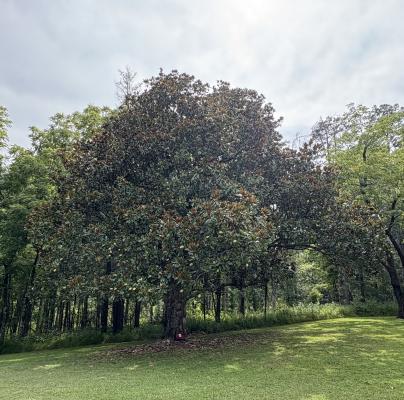
Species: Southern magnolia
Scientific Name: Magnolia grandiflora
Age: Over 140 years old
This tree holds historical significance because of the Kron family’s lasting influence on the early development of Stanly County. Dr. Francis Kron and his family moved to this property from across the river in 1834, naming their new home Attaway Hill.
The Kron family was celebrated for their horticultural expertise. They imported a wide variety of exotic fruits and vegetables from around the world, and Dr. Kron frequently experimented with grafting techniques in an effort to unite different tree species.
Dr. Kron was the first medical doctor to practice in the Uwharrie Mountains. He traveled extensively across the region, providing care to underserved communities with little or no access to quality healthcare. Beyond his medical work, Dr. Kron also served as a pharmacist, teacher, magistrate, scientist, and school superintendent, making him one of the area’s most respected early citizens.
The Salisbury–Fayetteville Road, a major travel route of the time, passed near the Kron homesite and connected travelers to the now-vanished community of Tindallsville. Once home to Montgomery County’s first courthouse and a popular river ferry, Tindallsville played an important role in the area’s early settlement and development.
Directions to the Witness Tree
The southern magnolia is located at the Kron homesite. From the park office, turn right out of the parking lot, then take the next right. Continue for approximately half a mile, then turn left and follow the road to the Kron parking area. From there, walk to the top of the staircase. When facing the front of the cabin, the southern magnolia stands at the edge of the clearing on the north side, to the left of the cabin.
About the Witness Tree
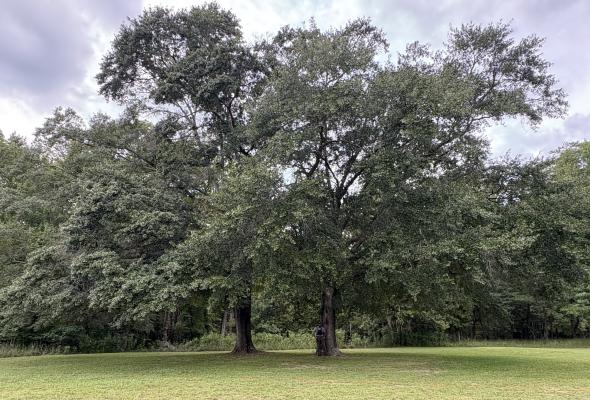
Species: Water oak
Scientific Name: Quercus nigra
Age: Over 100 years old
Both of these water oaks likely witnessed the transformation of the Yadkin-Pee Dee River into Lake Tillery, beginning with the dam’s construction and the subsequent flooding of the valley in 1928. They also would have stood sentinel over the community of Tindallsville — the first county seat of Montgomery County — during its final years.
Nearby, a popular ferry once crossed the river, serving as an important link along the Salisbury–Fayetteville Road. Before the Garrison Bridge was built in the 1920s, this ferry was the primary way to cross the Yadkin River. Dr. Francis Kron, the area’s first medical doctor, likely relied on this ferry in his travels across the Uwharrie Mountains.
Before the completion of the Narrows Dam around 1917, the Yadkin River followed its natural course through a rocky, turbulent gorge just upstream from what is now Morrow Mountain State Park. At its confluence with the Uwharrie River, it officially became the Pee Dee River — a point that today marks the endpoint of the Yadkin River State Trail which begins at the W. Kerr Scott Reservoir.
Directions to the Witness Tree
There are two large water oaks located near the boathouse. From the visitor center, turn right toward the lake and follow the road for approximately 1 mile to the parking lot. The trees stand in the open field beside the boathouse.
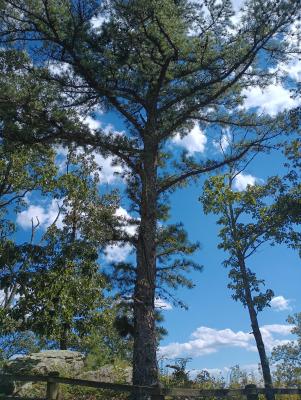
About the Witness Tree
Species: Pitch pine
Scientific Name: Pinus rigida
Age: About 100 years old
This is a strong and resilient pitch pine, older than any visitor to the park. Pitch pines can live up to around 250 years, and this tree has witnessed countless changes, struggles, and stories during its lifetime.
It began as a tiny acorn, clinging to the branches of another tree, until a wildfire cleared the way for it to grow. Pitch pines are unique — they have serotinous cones covered in resin that only open after fire, releasing seeds to start the next generation of trees.
Look closely at the bark, and you’ll see evidence of the challenges it has endured: past fires, lightning strikes, and insect activity. Today, controlled burns in the park help release this tree’s seeds so that new pitch pines can continue to tell the story of this landscape.
Directions to the Witness Tree
This tree is located near the Summit parking area. From the upper portion of the lot, take a short walk along the right side of the paved path that curves around the overlook area. You’ll find the tree near a kiosk that highlights important events and ecological information about Pilot Mountain.
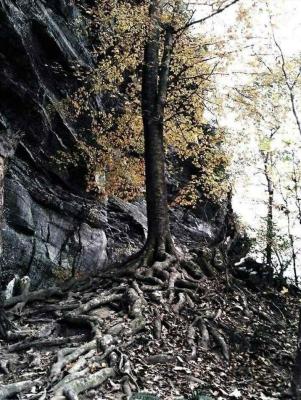
About the Witness Tree
Species: American beech
Scientific Name: Fagus grandifolia
Age: 170 years old
Nickname: "The Root Tree"
“The Root Tree,” as it is known to locals in Harnett County, is instantly recognizable when you hear the name. This impressive American beech is arguably photographed more often than Raven Rock itself. Over the years, it has outlived at least two sister trees that once grew nearby along the banks of the Cape Fear River.
The tree earned its name from its striking above-ground root system, which tumbles and twists over the fallen boulders of Raven Rock. These strong roots have anchored the tree through historical floods, record-breaking storms, and decades of natural and cultural changes in the area.
At roughly 170 years old, this American beech has witnessed much. It would have been a sapling during the Civil War, observed the evolution of industrial and commercial use along the river, and now stands as a beloved subject for thousands of photographs taken each year.
For locals, the tree is more than a picturesque landmark — it is part of the community’s heritage. Residents of Mamers, the area surrounding Raven Rock State Park, recall it fondly. As one native, Beth Johnson, shares:
“The Root Tree has always been part of my life. My family’s roots are as intertwined with this land as that tree’s are with the rock. Growing up just 2 miles from the park meant we visited often. Every year, my elementary school would take a field trip to Raven Rock, and we would take pictures of the whole class climbing those roots and ‘holding up’ the rock. I’ve had the joy of watching my child play on those roots, making memories with every reach. I’ve also had the honor of working at the park, helping protect the tree that means so much to our community. It is my profound wish that The Root Tree outlives us all, providing shade, habitat, and memories to everyone fortunate enough to see her in her glory. There may be older, taller trees in the park that could tell more stories, but I know there are no other trees about which more stories are told.”
“The Root Tree” is more than a tree — it is a living testament to resilience, history, and the bonds between people and the land they cherish.
Directions to the Witness Tree
The Root Tree” can be found off the Raven Rock Loop Trail, about a quarter mile to the left at the bottom of the Raven Rock stairs.
Please note: This trail is not wheelchair accessible. Reaching the tree requires descending and then climbing back up more than 130 steps. For the best experience, visit on weekdays during the morning or evening. Be mindful of park closing times as gates are locked.
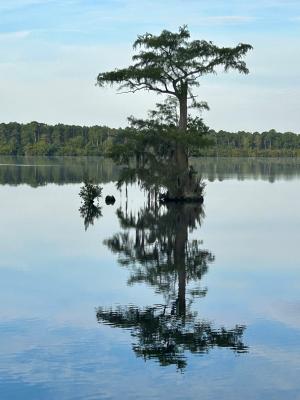
About the Witness Tree
Species: Bald cypress
Scientific Name: Taxodium distichum
Age: About 200-300 years old
This cypress tree likely stood here during the era when nearby longleaf pines were harvested for naval stores, producing tar, pitch, turpentine, and timber. In the 1930s, the land around it changed use: from 1936 to 1939, the federal government purchased the area and began developing it for recreation. The Civilian Conservation Corps built cabins, a dining and recreation hall, a bathhouse, and a workshop. By the summer of 1939, this tree would have witnessed groups visiting the lake for swimming, boating, fishing, and sunbathing — scout troops, 4-H clubs, religious organizations, and family reunions among them.
While much has changed since 1939, Singletary Lake State Park — and this enduring cypress — remain ready to welcome visitors, offering shade, history, and a connection to the natural and cultural heritage of the area.
Directions to the Witness Tree
This tree is located to the left of the pier as you walk toward the covered pavilion. The area is open to the public from 8 a.m. to 5 p.m. From the main entrance, continue into the park to the Educational Building, where parking and restrooms are available. Take the paved path to the left of the building and follow it straight to the pier — you’ll see the tree nearby.
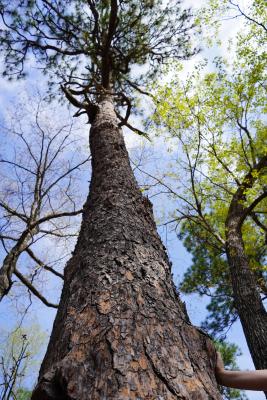
About the Witness Tree
Species: Longleaf pine
Scientific Name: Pinus palustris
Age: About 477 years old
Known as the “Old Tree,” this remarkable tree is estimated to be 477 years old. It was already 40 years old when John White attempted a settlement at Roanoke, over 200 years old when the Declaration of Independence was signed, more than 300 years old at the end of the Civil War, and over 400 years old when humans landed on the moon.
As you visit, take a moment to reflect on the centuries it has witnessed and the changes it may yet see. Gently place your hand on its trunk and imagine all the others who have done the same — you are sharing an experience with those who came before and those who will come after.
Directions to the Witness Tree
The witness tree is located along the easy, 1-mile Round Timber Trail at the Boyd Tract. It is marked as a place of interest on the park map.
About the Witness Tree
Species: White oak
Scientific Name: Quercus alba
Age: About 270-300 years old
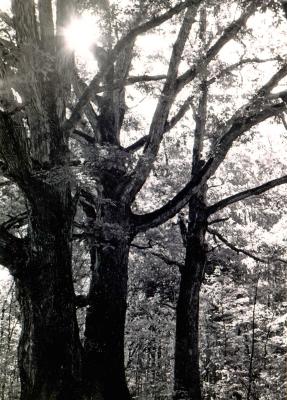
These oaks began growing around the time of the American Revolution, long before this area became part of Umstead State Park.
In the nineteenth century, the oaks were part of the daily landscape of the prosperous King Family, whose home once stood just across the road behind you. The family patriarch, William “Al” King (1829–1926), owned more than 300 acres of land that supported a bustling dairy farm, grist mill, blacksmith’s shop, orchards, livestock, and a cotton gin.
These trees also played a hands-on role in the Kings’ livelihood. For many years, they supported the family’s apple cider press, used to extract juice from the orchard’s fruit. The process involved stacking wooden boards over layers of apples and a filter made of fabric or straw. A large wooden beam, anchored into the trunk of one of these oaks, was used to press the stack and squeeze out the cider. This simple but effective press stood between these two trees until at least 1920 — and may have been built as early as the mid-1800s.
Today, these white oaks stand not just as natural landmarks but as living witnesses to the history of the King Family, and the everyday life of early Wake County settlers.
Directions to the Witness Tree
These historic trees stand along the Graylyn Multiuse Trail, beside the King Cemetery. From the Multiuse Trail parking area, walk up the access road and keep right until you reach the intersection with the Graylyn Multiuse Trail — about a quarter mile. Turn left, and after a short walk, you’ll arrive at the King Cemetery. The white oaks you see on the left side of the trail mark this special location.